Triss
Bride of AlvarTriss is Alvar’s first queen and the woman whose death exposes the lethal cost of a Cursed pregnancy for an ordinary human host. Although she appears only briefly in the surviving narrative, her absence governs Alvar’s guilt, his fear of intimacy, and his later insistence that Lucy Hammond is uniquely capable of bearing his children without dying.
Identity and Marriage
Triss married Alvar after the war ended, when he had been appointed king of Underland. Their marriage lasted less than a year before she died during pregnancy, making her both his first queen and a tragic predecessor to Lucy Hammond. The news reaches Lucy through Grey, one of her guards, who explains that Triss died while pregnant and describes the event as a tragedy. Lucy’s immediate shock is intensified by the fact that Alvar had not told her he was a widower. Triss therefore enters the story first as a concealed part of Alvar’s history: a queen whose memory has been withheld until Lucy is already emotionally and politically bound to him.
The narrative later supplies a second, darker version of Triss’s identity. Before becoming queen, she was a young slave-girl associated with Alvar’s captivity. Dressed in a revealing, gold-encrusted garment, she comes to his cell and identifies herself as “Triss.” Her visit is not presented as an ordinary romantic meeting. Under Hyphus’s threatening supervision, she says that she wants to be eaten by Alvar, a statement that places her desire within the violent social order surrounding the Cursed rather than within the language of courtship. This earlier appearance makes her later queenship a radical change in status, while also connecting the queen’s story to slavery, bodily danger, and the desperate forms of agency available to women under coercive rule.
The Pregnancy and Death
Triss’s death is caused by the interaction between Alvar’s Cursed nature and her ordinary human body. In the room she shared with Alvar, she lies on their bed with her features sallow and drained of life. The child is consuming her system, and the Curse does not tolerate an average human host. A physician tells Alvar that the condition is not a normal pregnancy difficulty but a magical problem brought on by a dark Curse. The language of diagnosis does not lessen the personal catastrophe: the pregnancy turns the future heir of Underland into the mechanism of the queen’s destruction.
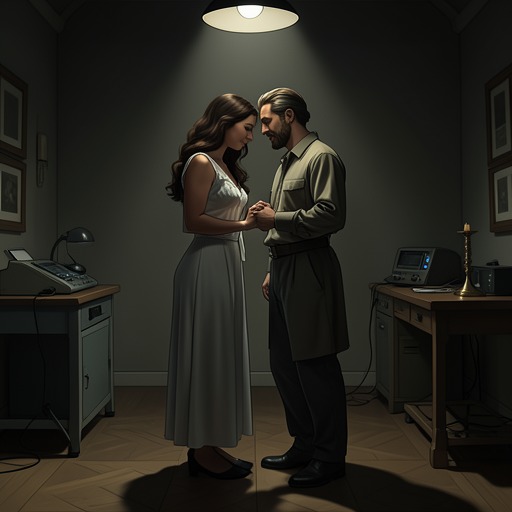
Alvar responds by promising to save her. He kneels beside the bed, takes her cold hands, and urges her not to give up, while Triss, already dying, tells him that he has already saved her. Her words transform the scene from a failed rescue into an acknowledgment of the love and acceptance she had given him. She had accepted and wanted his love from their first night together, and even in her final weakness she refuses to make him carry the entire burden of blame. Her composure contrasts sharply with Alvar’s self-condemnation: he sees himself as a scourge who destroys everyone he loves, while Triss attempts to release him from guilt even as the consequences of his Curse become irreversible.
Alvar nevertheless accepts responsibility. He later admits that Triss had not possessed a drop of Cursed blood and that he destroyed her by impregnating her. He calls himself a fool for not understanding how Cursed pregnancies worked. This confession establishes the central biological and ethical fact of Triss’s tragedy: her death was not an arbitrary illness but the result of Alvar’s ignorance about the conditions required for a safe pregnancy. The loss becomes the original evidence behind his fear that fatherhood will kill another woman.
Influence on Alvar and Lucy
Triss remains present after death through the decisions her loss forces Alvar to make. When Sola tells him that Hannah Delaney is carrying a child who is dying in her womb, she instructs him to cross the Bridge, infuse Cursed blood into the unborn child, and use healing magic to save it. The proposed rescue offers Alvar a political alliance and a chance to secure heirs, but it also repeats the circumstances that led to Triss’s death. His first response is refusal: he is determined not to endanger another woman because he believes he cannot have children without possibly killing their mother.
The difference between Triss and Lucy Hammond is explained through the intervention that saved Lucy before birth. Hannah Delaney promised Alvar that her daughter would become his bride if he healed her, and the agreement dated October 10, 1993, on Earth and the twenty-third day of Havath, 2918, in Axus, binds the unborn child to Alvar as a future wife and queen. Alvar later explains that Cursed blood was infused into Lucy while she was still in the womb. That blood gives her rapid healing and, crucially, makes her the only person he knows with certainty who can carry his children without dying. Triss’s death is therefore the negative condition against which Lucy’s survival is measured: one woman’s body could not withstand the pregnancy, while another was altered before birth so that the same danger might not recur.
Alvar’s later research, confirmed by multiple record keepers including Father Ryland, leads him to believe that Lucy can survive bearing his children. He also explains that not all of their children would necessarily be Cursed. This knowledge does not erase Triss’s place in his history. Instead, it converts her death into the foundation of a new reproductive and dynastic policy, linking private grief to the succession of Underland and to the Earth–Axus treaty. Lucy is valued simultaneously as a political bride, a possible mother of heirs, and a person Alvar loves; Triss’s fate shows the dangerous cost of treating those roles as interchangeable.
Legacy and Narrative Significance
Triss functions as both a dead queen and a living warning. Her short marriage to Alvar, her pregnancy, and her death explain why he distrusts his own capacity for love and parenthood. They also complicate his attraction to Lucy: Lucy is not merely replacing a former wife, because she is the first woman Alvar believes can survive the inheritance of his Cursed blood. The relationship is haunted by comparison even when Triss is not physically present.
The narrative gives Triss’s death a retrospective significance when Lucy later learns that Alvar has again given her his Cursed blood to save her life. Lucy recognizes that he once gave the same blood to her while she was dying in Hannah Delaney’s womb. The repeated act creates a deliberate contrast between the two queens. Alvar’s blood once helped save a child before birth but contributed to the death of the woman carrying his child; later, the same power becomes the means of preserving Lucy after danger has struck her. The repetition does not undo the earlier tragedy. It shows how Alvar’s knowledge, guilt, and protective impulse have been reshaped by Triss’s death.
Triss’s legacy also reaches into the future of the monarchy. Sola tells Queen Lucy that she and Alvar will have two children, one like Lucy and one like Alvar, with his red eyes, and predicts that a non-Cursed heir will eventually take the throne after their rule. This prophecy places Triss’s failed pregnancy within a larger dynastic sequence. Her death marks the point at which Alvar learns that desire, kingship, and reproduction cannot be separated from the Curse’s physical consequences; the children promised to Lucy represent not a simple replacement for the child Triss could not safely bear, but the possibility that Underland’s succession can continue without repeating her fate.